

The Transverse Lunge (also called a rotational lunge or lateral rotational lunge) is a functional movement exercise that adds a rotational component to a traditional lunge.
Instead of stepping straight forward or backward, you step out diagonally at a 45-degree angle, rotating your body as you lunge. This challenges your body in the transverse plane of motion — hence the name.
What makes it different from a regular lunge:
Standard lunges move in the sagittal plane (forward/backward)
Transverse lunges incorporate rotation, engaging the hips, glutes, and core in a more multi-directional way
Key benefits:
Improves hip mobility and flexibility (especially hip external rotation)
Strengthens the glutes, quads, hamstrings, and adductors
Enhances balance and coordination
Trains movement patterns used in sports and everyday life (twisting, changing direction)
Helps prevent injuries by strengthening often-neglected movement planes
Muscles Worked
Target: glutes (gluteus maximus), quads (quadriceps)
Synergists: hamstrings, hip adductors, hip external rotators
Stabilizers: core (abdominals), obliques, calves
Active joints: hip, knee, ankle
How to Do It
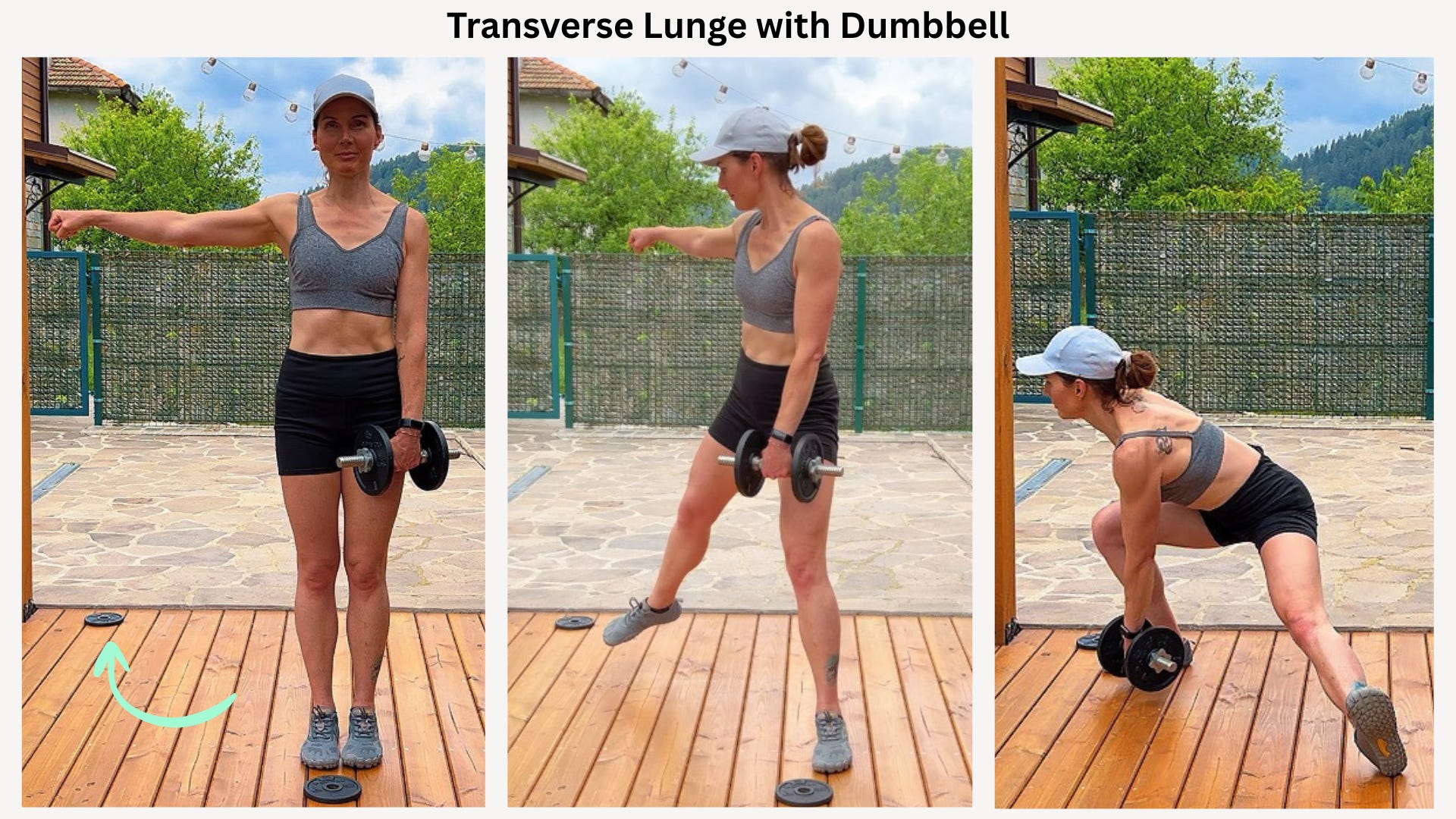
Hold one dumbbell at your side in the hand opposite to the direction you’re stepping. Extend the free arm out to the side at shoulder height and make a fist. The fist engages the muscles of the shoulder and upper back through irradiation — a neurological effect where tension in one part of the body increases stability throughout. It also serves as a natural counterbalance to the weight on the other side.
Stand tall with feet together.
Step diagonally forward at a 45-degree angle — to the 10 o’clock position with the left foot, or 2 o’clock with the right — on the side opposite the dumbbell.
As you step, rotate your torso toward the lunging leg and begin to sink into the lunge.
At the bottom of the lunge, lower the dumbbell to the inside of the working leg.
Lift the toes of the straight leg for an extra hamstring stretch.
Push through the front foot and return to the starting position.
Complete all reps on the same side, then switch.
The extended fist arm stays active throughout — don’t let it drop or go slack. That tension is doing work.
Control the rotation. The twist should come from the hips and torso together, not just the shoulders.
Step far enough. A short step reduces hip engagement and limits range of motion. Aim for a stride that lets you sink into a comfortable lunge depth.
Common Mistakes
Skipping the rotation. Stepping out without rotating the torso turns this into a regular lateral lunge. The rotation is the exercise.
Knee caving inward. The front knee should track over the toes throughout. Collapse here puts unnecessary stress on the joint.
Letting the extended arm drop. The opposite arm is part of the movement. A passive arm means less stability and less benefit.
Taking too short a step. A narrow stride limits hip engagement and reduces range of motion. Step out enough to feel the hips load.
Rushing the movement. This is a controlled, multi-planar exercise. Moving too fast through the rotation sacrifices both form and balance.
Sets and Reps
3 sets of 6 reps per side. Complete all 6 reps on one side before switching.
Rest 60–90 seconds between sets.
Start with a light dumbbell to learn the rotation pattern before adding load.
When you try the Transverse Lunge, does one side feel different from the other — and if so, what do you notice? Let me know in the comments.
I have a difficult time with rear and forward lunges because of my knee. I can do side lunges and squats so these look good.