
Three Weeks of 30-Minute Workouts. Foundation Strength Phase 2
30-minute full-body dumbbell workouts for weeks 4–6 of Foundation Strength. More single-leg work, more core demand, plus the program PDF with a built-in tracking sheet.

Hi friends,
How did Foundation Strength Phase 1 go?
If you are new here or didn’t have the chance to do the program yet—nothing is lost.
Here are the workouts in Foundation Strength, Phase 1 again:
We are now moving to Phase 2, with more complex exercise selections, but with the same relentless focus on movement quality first.
The format remains the same: three workouts per week, each fits within 30 minutes. We do the same three workouts for three weeks in a row, because we want to master the movement and give ourselves two chances to challenge the weight or reps. I’ve found three weeks to be the sweet spot: long enough to get good at a move and push it heavier, then we change things up.
Here’s what you’re getting today:
Three weeks of 30-minute workouts (free members get Workout 1, paid members get the full program)—four exercises per workout, twelve exercises per week covering all major muscle groups, each session done in 30 minutes with dumbbells at home
Video demos performed by me with written cues for all exercises—if something’s unclear, just ask; I read and respond to all comments
The complete Phase 2 program as a PDF (paid subscribers)—links to every exercise video plus a built-in tracking sheet on each workout page, so you don’t have to scroll through posts to find it later
What you will need:
Adjustable bench
Set of dumbbells
Your Weekly Schedule
Aim for all three workouts each week, on whatever days fit your life. A rest day between sessions is ideal, but because the per-session volume for each muscle group is low, back-to-back days are fine when your schedule demands it. Miss a workout? Don’t skip it—just pick up where you left off.
Choosing Weights
Pick a weight where the last two or three reps of each set are challenging but doable with perfect form. When in doubt, go lighter and build up. Rest about 60-90 seconds between sets.
Short on Time or Energy?
The program is designed so you shouldn’t have to cut it short—but if life happens, do two sets of each exercise instead of three. Something always beats nothing.
Video Demos
Every exercise below includes a short written cue and a video demo by me. Watch the movement, then use the written cues as your coaching. If in doubt, ask me; I read and reply to all comments.
Let’s get to it.
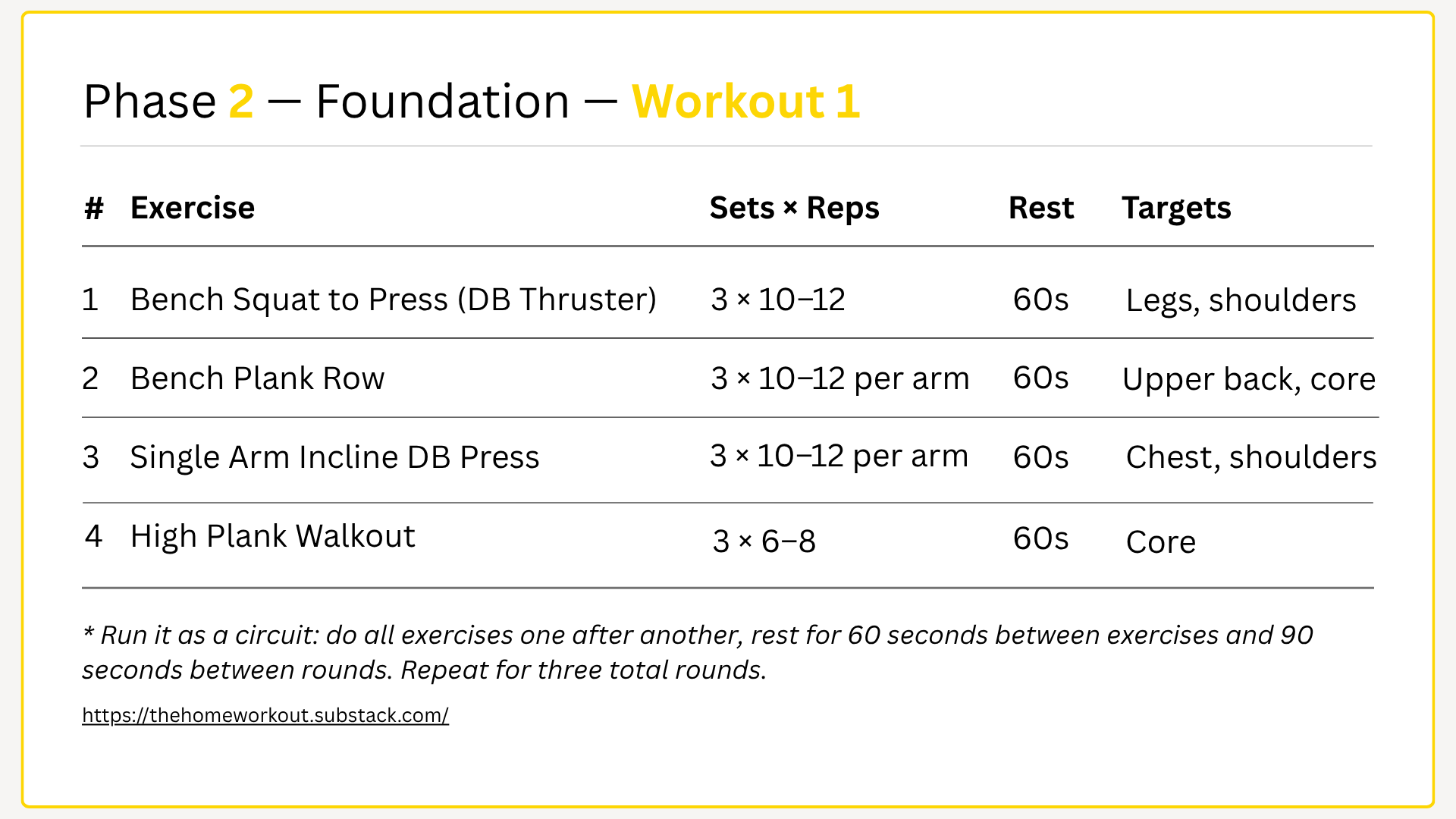
Workout 1
Full-body power, chest, back, shoulders, core
Exercise Notes—Workout 1
Bench Squat to Press (DB Thruster)
10-12 reps per set
This is a full-body exercise combining a squat and an overhead press into one movement. You work legs, shoulders, and core together and get your heart rate up at the same time. The two parts of the exercise—the squat and the press—aren't separate: the drive out of the squat transfers power straight into the press, which is why you can push more weight overhead here than you could pressing from a standstill.
Begin standing in front of a bench with two dumbbells (DBs) at your shoulders. I use a bench as a depth gauge, but you can go without it. Squat until you tap the bench, then stand and press both DBs straight overhead in one movement—let your legs help launch the press. Bring the DBs back to your shoulders, squat to tap the bench, and repeat. Keep it as one continuous rep rather than pausing at the top of the squat, so the leg drive actually carries the DBs up.
Bench Plank Row
10-12 reps per arm
The plank position makes this row variation more challenging than the 3-Point Dumbbell Row, the Staggered Stance Bentover Row, and the Batwing Row from Phase 1.
Begin by placing your hands on the bench in a plank position, body forming a straight line. To increase the challenge and core demand, bring your feet together; to make it easier, keep a wider stance. Row one DB up to your hip. Keep your hips square to the floor and don't twist toward the DB as it comes up. I like to row slow and controlled rather than yanking the DB up, since rushing it is what breaks your position and lets the hips rotate.
Single Arm Incline Dumbbell Bench Press
10-12 reps per arm
The incline bench press sits between horizontal flat bench (classic barbell bench press) and vertical (overhead press). You primarily work the upper chest, shoulders, and triceps. But because you are training unilaterally, there is also great activation of the obliques, and even spinal muscles working together to resist rotation. Set an adjustable bench to a 45-degree angle and keep your back firmly pressed onto the backrest throughout the movement. Hold one dumbbell at chest level with a neutral grip and press it upward. Keep your ribs down and hips leveled so the loaded side doesn’t twist you off the bench. I like to keep my free hand extended up the whole time, making a fist, which helps with bracing and allows for more controlled movement.
High Plank Walkout
6-8 reps
First, this is not a plank. You get to a high plank position—therefore the name—but you walk your arms out to it and back. That changes completely what this exercise is about. Every time you walk your hands out, your base gets longer and the load on your spine shifts, so your core has to re-stabilize and hold the line again. You're training your lower back and pelvis to stay steady while your limbs move, which is exactly what your back has to do when you bend down to grab something off the floor with no warm-up. You'll mainly feel it in your abs and deep core, but the exercise also loads your shoulders at various degrees as you walk out and back. Start by standing tall with your feet together or shoulder-width apart, whichever feels more comfortable. Hinge at the hips and bend your knees as much as you need to get both hands flat on the floor, then walk your hands forward until you reach a plank with your body in a straight line from head to heels, lower back neither arched nor sagging. Don't let your hips drop as you reach out. Hold for a breath, then walk your hands back toward your feet and stand tall. Work on a non-slip surface so your hands don't slide.
