
Foundation Workout 2: The Hinge / Pull Session
Hamstrings, glutes, back, and core in 30 minutes—plus the Foolproof Hinge Guide, your cardio plan, and the printable tracking sheet.

By now you’ve done Workout 1. Maybe more than once.
Workout 1 was the squat/press session, and it’s free for everyone here: Foundation Workout 1.
Workout 2 builds your training plan.
Where Workout 1 had you pushing weight up, this one has you pulling it in and hinging it back. Hamstrings and glutes take over from quads. Your back does more of the work. And you’ll practice the hip hinge—the movement I’d teach first if I could only teach one.
Here’s what you’re getting today:
The full Workout 2 session—four exercises, three sets each, done in 30 minutes with dumbbells at home
Video demos with written cues for all exercises
The Foolproof Hinge Guide—why “slide the dumbbells down your thighs” isn’t a good enough cue, and the three 60-second checks that make you a master of the hinge
Cardio recommendations for a well-rounded training plan that comes out to less than 3 hours total (strength + cardio)
The printable Progress Tracking Sheet for Phase 1 of the program
You’ll repeat this workout once a week for three weeks. That gives you enough time to try to beat last week’s numbers, and next week I will show you a few ways to do that. The tracking sheet at the bottom is how you’ll know you did.
Let’s get to it.
Workout 2—Hinge / Pull Focus
Hamstrings, glutes, back, chest, core
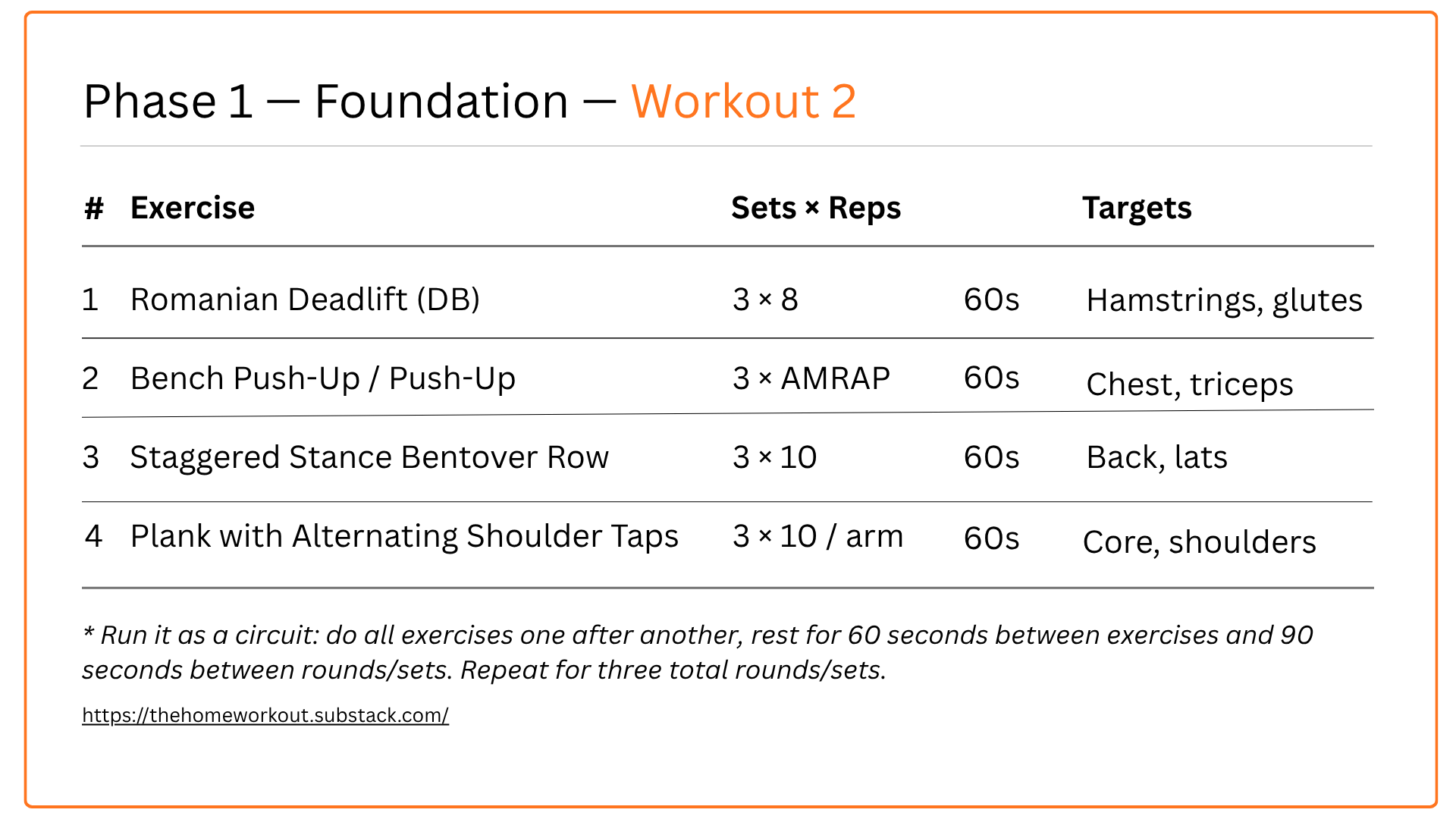
Run it as a circuit: do all exercises one after another, rest 60 seconds between exercises and 90 seconds between rounds/sets. Repeat for three total rounds/sets.
Pick a weight where the last two or three reps are challenging but doable with perfect form. When in doubt, go lighter— you have three weeks to build up, and you will.
Exercise Notes
Romanian Deadlift
This one builds your entire backside—hamstrings, glutes, and the strength to pick things up off the floor for the rest of your life. Stand tall with the two dumbbells in each hand, knees straight but not locked. Hinge your hips back—push your butt back as far as you can while keeping a neutral spine. Don’t round your back on the way down, and don’t crank your neck to look forward; keep it natural. Stand up by squeezing your glutes.
8 reps
▶ Watch the Romanian Deadlift demo
Read the Foolproof Hinge Guide below for a perfect hip hinge every time.
Bench Push-Up / Push-Up
The most underrated upper-body exercise there is. Hands on a bench (or the floor for the harder version), body in one straight line from head to heels. Lower your chest with control, elbows at roughly 45 degrees, and press away without letting your hips sag. The set ends the moment your form breaks, not when you collapse.
AMRAP—as many quality reps as you can
▶ Watch the Bench Push-Up demo
Staggered Stance Bent Over Row
Rows build the upper back that holds you tall—better posture, stronger pulls, healthier shoulders. Take a staggered stance with one foot slightly behind, hinge at the hips, and keep your back flat. Row the dumbbells to your hips, keeping your shoulders square and your elbows finishing at about 90 degrees. No shrugging—the row comes from your back, not momentum.
▶ Watch the Staggered Stance Bent Over demo
Plank with Alternating Shoulder Taps
One of your core’s key jobs is resisting movement, and this exercise trains exactly that. Set up in a high plank with feet slightly wider than usual for a stable base. Tap the opposite shoulder with one hand while keeping your hips completely still—imagine balancing a glass of water on your lower back. Slow and controlled beats fast every time.
3 × 10 / arm
▶ Watch the Plank with Alternating Shoulder Taps demo
The Foolproof Hinge Guide: 3 Checks That Take 60 Seconds
Two exercises in this workout depend on one skill: the hip hinge. The RDL is a hinge. The staggered stance row starts from one.
Get the hinge right and your hamstrings and glutes do the work they were built for. Get it wrong and your lower back takes over—which is fine for a rep or two and could turn into a problem by week three.
The difference in one line: a squat goes down, a hinge goes back.
Here’s how to know which one you’re doing. Run these three checks before your first RDL set. They take about a minute, and they’ll calibrate every hinge you do for the rest of the program.
