
Walkout and Inchworm Variations
Give your back the control it relies on when you're moving.

Hi friends,
Building strength in the gym is only useful if we stay injury-free outside of it, right? There is nothing worse than being strong in your deadlift, but straining your back picking your socks up off the floor. One reason strong people still get injured in everyday situations like this is that gym lifts are rehearsed—we set up, brace, and move a load we're ready for—while real life skips the warm-up and hands us a bad angle with no warning. That’s why exercises like walkouts and inchworms have a place in our strength program. They put our bodies in positions that demand control without a setup, very much like real life.
Plank, Walkout, Inchworm—Aren’t They The Same?
Fair question—the plank is right in the middle of both, so it’s easy to think they’re the same exercise with some extra steps on top. But there is a real difference that earns its own place in your training.
A high plank is a static hold. You get into the position and hold it. Great for building the endurance to keep a solid position under load, but it pretty much starts and ends there.
Walkouts and inchworms use that same plank as a checkpoint, but don’t stop there. The actual exercise is getting to plank and back. As you walk your hands out from your feet, your base of support keeps changing and your weight shifts forward. Your trunk has to keep re-stabilizing with every small step out and back. Inchworms add the walk-in, which loads your hamstrings through a stretch on top of it.
That constant re-stabilizing—staying in control while everything's moving—is closer to how your back actually gets used.
Why Train It
There is something important a plank leaves out. Your back rarely gets to work in one fixed position in real life. What it actually has to do all day is stay steady while your arms and legs move around it and the load on your spine keeps shifting. That skill has a name: lumbopelvic control—keeping your lower back and pelvis stable while your limbs move. And it matters more than the complicated name suggests.
People with chronic low back pain tend to have measurably worse lumbopelvic control than people without it—the two are clearly linked.1 But I want to be straight with you about what that does and doesn’t mean: it isn’t proof that one exercise fixes a bad back, because back pain has many causes. However, it does tell us this control is worth training, and that’s exactly what walkouts and inchworms are for.
So here are four of my favorites, and one that comes with a warning.
High Plank Walkout
This is the variation to begin with and work your way to more advanced ones.
Stand with your feet shoulder-width apart. Hinge at the hips and bend your knees as much as you need to reach the floor with both hands flat. Slowly walk your hands forward until you reach a plank position with your body in a straight line from head to heels—keep your back stable, lower back neither arched nor sagging. Hold there for a breath, then reverse the movement—walk your hands back toward your feet and stand tall. Make sure you are using a non-slip surface so your hands don’t slide.
Push-Up Walkout
Walk out to the same plank position. Once you’re stable, do one push-up—lower your chest under control, then press back up. Walk your hands back to your feet and stand. Same anti-extension work plus chest, shoulders, and triceps on top of it.
Inchworm (the base movement)
An inchworm differs from a walkout in one detail: after you reach the plank, you walk your feet toward your hands instead of walking your hands back to your feet, so your body travels forward across the floor. From standing, hinge and place your hands down, walk your hands out to a plank, then keep your legs as straight as you can and walk your feet toward your hands in small steps until you’re folded at the hips again. Stand, and repeat. Straight legs load the hamstrings through a stretch on the walk-in; bend the knees if that range isn’t available to you yet.
Inchworm Push-Up
Run the same inchworm, but add one push-up at the plank before you walk your feet in. So: hinge, hands down, walk out to a plank, one controlled push-up, then walk the feet toward the hands, stand, repeat. This is the moving version of the Push-Up Walkout—same pressing work, with the added hamstring stretch and forward travel of the inchworm.
Long Lever Inchworm
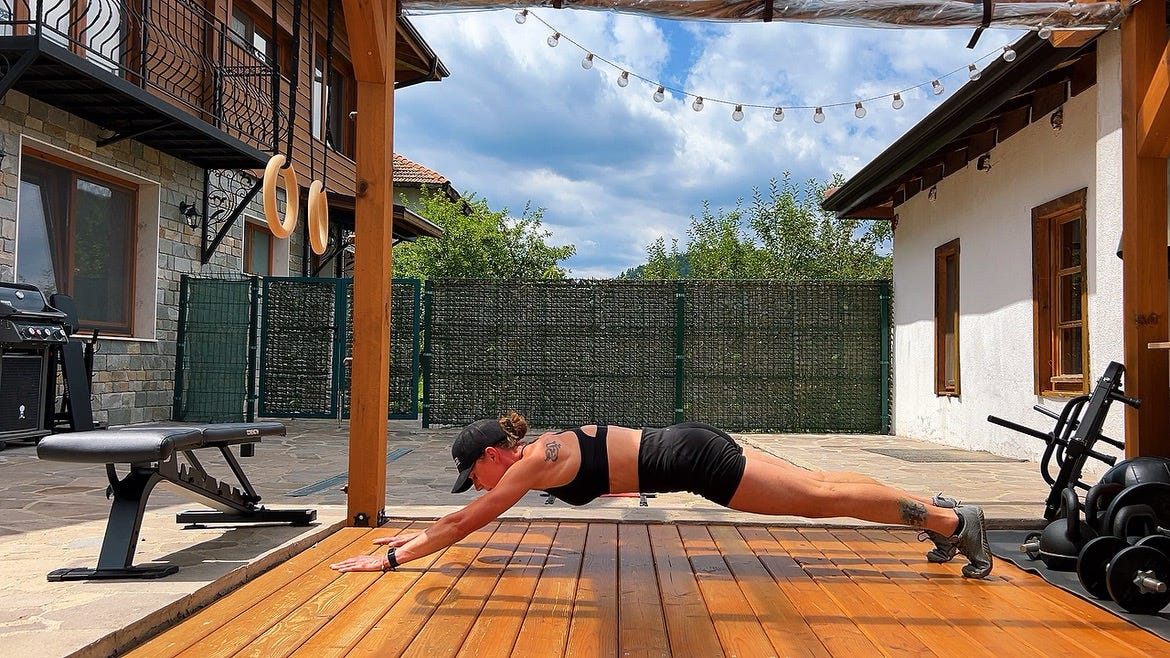
This is the hardest of the group and the one I want to flag. It lengthens the lever—instead of stopping at a standard plank, you walk your hands out past your shoulders until your arms are extended well ahead of you. The farther your hands reach, the harder your abdominals work to keep your lower back from sinking. Walk out only as far as you can hold a flat back, pause, then walk your feet in or your hands back. If your hips drop or your back starts to arch, you’ve reached past your controllable range—shorten the reach.
* This is an advanced version of the other three, and it may be tempting to get there, but the long reach loads the shoulder in deep flexion while it's stabilizing under bodyweight, which is a demanding spot for the joint. Because of that, I don’t train it very much. Someone whose shoulders tolerate that position better than mine may find it perfectly fine—just build up to it rather than jumping straight in.
Sets and Reps
Treat these as low-rep, control-focused work. For the High Plank Walkout and Inchworm, 2 to 3 sets of 5 to 8 slow reps are plenty. For the push-up versions, drop to 3 to 6 reps, since the press adds fatigue. The Long Lever Inchworm is demanding enough that 3 to 5 quality reps is plenty. Rest 45 to 90 seconds between sets. As a warm-up before a heavier session, one or two rounds of 5 is enough.
Do you have a favorite? I like the push-up variations myself and to rotate between the walkout and an inchworm. How about you?
Train well.
—Irina.
Jung S-h, Hwang U-j, Ahn S-h, Kim H-a, Kim J-h, Kwon O-y. "Lumbopelvic motor control function between patients with chronic low back pain and healthy controls: a useful distinguishing tool: The STROBE study." Medicine (Baltimore). 2020;99(15):e19621. https://doi.org/10.1097/MD.0000000000019621
Such great workouts and tips here Irina.